Thursday, 1 March 2018

Portraiture as Taxidermy

I don't write as much as I should on the arts, but this piece on Ben Skinner's photography was carried in Joburg Style Magazine, Issue 22, Johannesburg September-November 2013.


 Michael Schmidt © Ben Skinner 2011

At first sight, he strikes a Bowie-like figure; tall, lanky, pallid, androgenous, and clearly a man-out-of-time. But Ben Skinner’s time is not the future, but the Victorian era, with all its dandyish sensuality and imperial bloody-mindedness bound by a thin hide of civilisation.
His woolly mutton-chop sideburns and Daliesque curled moustache are the most apparent signs of his predilections. His pale eyes are coolly appraising behind his round tortoise-shell glasses give warning of the deep arrogance of a craftsman besieged by today’s disposable, corner-cutting culture.
For Skinner is not only a perfectionist in his tailoring – whipping up with dash a woman’s pant’s suit of breathtakingly daring construction and sublime fit with consummate ease – but he appears to excel at anything he puts his long bony hands to, from set-building to photography.
His studio, at 61 Sixth Street, Parkhurst, bursts at the seams with insights into his unusual competencies. The location of bespoke corsetry firm Arwen Garmentry – run by Skinner and his partner Arwen Swan – the studio is not only the showcase of Swan’s refined and exacting wearable works-of-art in lush brocades, silks, satins and exotic fabrics, but it is the couple’s home, an aviary for a bewildering array of species, and a workshop where a small staff conjure wonders on their sewing machines.
Rowdy candy-striped corsets jostle for space on the rails with svelte silvery evening gowns, while a display case boasts antique top hats, gloves, eyeglasses, and medical instruments; the gleaming steel jib of a former X-ray machine provides the desk with an arc of light. A railway signal, shorn off its mountings by an elephant near Victoria Falls, recalls Skinner’s Zimbabwean origins. When Skinner fires up the beautiful old St Marco cappuccino machine, the room is transformed into a salon, where intellectuals and artists joust.
But when the crowds have gone, the studio becomes Skinner’s photographic playground. Mostly he shoots for Swan’s discerning and conservative market, as shown on her website www.arwen.co.za, but frequently, he lets his considerable imagination run riot. 
With digital photography, many lazy practitioners simply shoot tons of images, and spend a lot of time fixing their errors with Photoshop. Not so Skinner; his work ethic sees him building his own sets, then spending an entire morning getting the lighting just right, whether it is bleached-out, ethereal, hard-etched, or sunk in gloom like an Old Master oil painting. 
His “models” are startlingly real, few of them conforming to bland, shapeless fashion stereotypes, and so you will find corpulent women and hirsute men; but whatever their physique, his unerring eye draws out of them an inner essence. As an African portraitist, Skinner is aware of the traditional fear that photographs entrap the soul; like an eccentric Victorian collector with a butterfly-net, he stalks them, follows the path of their fear and captures that instance of self-recognition; true to his surname, he incisively gets under their skin.
Many of these images are nudes, but not the human body idealised; here there is both an unblinking honesty, and yet the intrigue of an inner story suggested by the moment in which the viewer finds them, like antediluvian creatures trapped in amber. Playfulness abounds, as in his “Fairy Tale” series, but also a distinct undercurrent of the macabre, as with his “Bad Nurses” series of nightmarish surgery. And the detournment of convention is signaled by a planned series turning political figures such as Black Panther Bobby Seale and apartheid architect HF Verwoerd inside out.
Never yet published or exhibited, this demanding young man is sure to soon be recognised as one of Africa’s most exciting new portrait photographers.


Bad Nurses © Ben Skinner 2013

[ENDS]

Storming the Bastille of the Bourgeois Media

The wonderful editor and staff of Alexandra, Johannesburg, community newspaper Alex Pioneer who I mentored in streamlining their editorial and production processes in parallel to best serve their township readership. 

This is an article I wrote for the Jozi Book Fair in 20011 in my capacities as Executive Director of the Institute for the Advancement of Journalism and Administrative Secretary of the Professional Journalists’ Association of South Africa

When Lucien van der Walt and I launched our book Black Flame, I was challenged from the floor by a young revolutionary who accused me of having worked for the bourgeois press. And what could I say, because indeed I had spent 19 years working for the bourgeois press, the last three as group special investigative writer for Independent Newspapers. But her accusation begged two key questions: why, in the million-flower blooming of South Africa’s democracy had our alternative press died; and whether it was at all possible to maintain a pro-poor political stance within the bourgeois press? 
As I write this under a poster for the sadly-missed Progress Press of Braamfontein, I can’t think of many ironies as great in this country’s transition but that the alternative press, whose journalists had suffered censure, bannings, buggings and even torture to ensure the dawn of democracy, would go down to extinction as the society they fought for came to life. Part of the answer why this happened is cold capitalist logic: the sole survivor of the alternative newspapers of that era, the Mail&Guardian (formerly the Weekly Mail) was until recently heavily propped up by the British Guardian. And the other reason is that the alternative press, like so many other anti-apartheid formations, struggled to maintain its sense of mission once apartheid collapsed. 
But this is not to say that all is entirely lost: the extra-parliamentary left maintains its own journals; and we have seen new initiatives come to the fore, such as the non-sectarian Amandla! Journal, the pan-African progressive analytical site Pambazuka News, and the global phenomenon of indymedia. And certainly not least, we have the dramatic expansion of South Africa’s community media, with today some 150 community radio stations and a handful of community TV stations. This is not to say the sector is all-triumphant: the National Community Radio Forum’s provincial chapters apparently focus almost exclusively on advertising revenue, rather than on quality editorial content; some “community TV stations” are really just small-footprint commercial stations, while some “community newspapers” are owned by the giant Caxton group; and the ICASA Amendment Bill threatens enforcing a relationship between community radio stations and municipalities that smacks of corporativism.
There are huge financial challenges to establishing vernacular-language community media in remote rural parts of the country. I’ve done some feasibility studies in such areas and they are instructive about the pressing social need for such a media – and the enormous hurdles faced. It takes guts and really fancy financial footwork for them to stand a chance. But the key to success is the need to understand social ownership: most community publications are the pet projects of their editors. But the moment they are founded, they are sometimes amazed at the welter of interest – and criticism – they encounter. This is because newspapers are not simply a product or a business; no, they are social capital, integrated into the social fabric, and their readers increasingly in a very real sense take over “social ownership” from the editor and her or his team. 
This is a lesson that must be learned by the mainstream media too: that social ownership is not only the best defence against demagogues who would restrict the free flow of information in SA, but it can make for the best content. Sadly it’s pretty easy to go through the lead stories of today’s newspapers and find sensationalism, fluff, spin, and at times errors of fact.
In a March 2011 article titled Journalism, Democracy… and Class Struggle, Robert McChesney argued that the rise of so-called “professional journalism” came with three in-built biases: First, it narrowed the potential pool of legitimate story sources to officials and prominent public figures which “gave those in political office (and, to a lesser extent, business) considerable power to set the news agenda…” Second, by insisting that there had to be a news hook to justify the story, “crucial social issues like racism or environmental degradation fell through the cracks of journalism unless there was some event, like a demonstration or the release of an official report, to justify coverage.”
And third, professional journalism, “far from being politically neutral… smuggles in values conducive to the commercial aims of the owners and advertisers as well as the political aims of the owning class... And of government activities, those that serve the poor (e.g., welfare) get much more critical attention than those that serve primarily the interests of the wealthy (e.g., the … institutions of the national security state), which are strictly off-limits.”
That’s an exceptionally harsh, yet accurate, assessment – I experienced those exact pressures in my almost two decades as a journalist – but there are harsher judgments: Alexander Cockburn, editor of the online American alternative political journal CounterPunch, in a June 2009 column titled Who Needs Yesterday’s Papers?, stated bluntly that apart from “a brief flare-up of investigative zeal” in the early to mid-1970s, “any exacting assessment of the actual performance of newspapers rated against the twaddle about the role of the Fourth Estate spouted by publishers and editors at their annual conventions would issue a negative verdict in every era”. 
So where do we look to for quality, public-interest journalism in South Africa today? Presumably the place to start is investigative journalism, yet the track record over recent years has been quite mixed, in part because of several systemic problems. On the plus side, investigations units have sprouted up all around, from the Mail&Guardian’s “AmaBhungane” unit to M-Net’s Carte Blanche. We have even seen some (rare) independent investigations by the financial press, reporting on the skulduggery of their owners. But far more often, those media owners sabotage their own investigators. I’ll let one of the country’s award-winning investigative journalists speak for himself: “My editors have issued instructions that we not write more than 500 words – that’s impossible, given the complexity of some of our investigations. There is so much other stuff to investigate, but all they are interested in is busting political leaders for corruption.”
So how do we improve things? The Arab Spring has certainly demonstrated the liberatory potential of social media and citizen journalism – but the power imbalance between that media and the capitalist media is such that while we need to rebuild our alternative media around this potential, at the same time, it is crucial that we storm the Bastille of the traditional bourgeois media by campaigning vigorously for its radical democratisation. And by that I don’t mean nationalisation, but socialisation – eventually of ownership yes, but starting with the socialisation of the media’s content, the transformation of so-called “objective,” professional journalism into a socially-engaged journalism that advocates for the poor majority, for coverage of real issues instead of political spats and bling. At the moment, we can name specialist labour and poverty reporters on one hand; we, the readers and audience, need to pressure editors to change that.
Strangely, an intriguing socialisation initiative came from within the bourgeois press when Daily Dispatch in East London reversed the way newspapers usually news-gather by running a series of public Community Dialogues in which the news agenda was set by the communities instead of by the journalists. This process was not without its flaws; Rod Amner has argued in his study of the process that such socially-conscious journalism still had to battle against “the political economy of the commercial press... driven by deadlines, production quotas and profitability” – and that the weakness of civil society generally undermined such “public journalism”.
But there is a sea-change under way: for one thing, audiences have become pretty sophisticated at interrogating how the news is manufactured; and for another, social media has created new, constantly-shifting social polities that have wielded power within the mainstream media in ways that have at times been breathtaking (think Wikileaks). It’s time to wrest the mass media back from mahogany-row vested interests, time to entrench a progressive popular agenda as the core of what makes them financially viable.


The inaugural editorial of June-July 2009 in Ponelopele News, a rural Twana-and-English newspaper for which I am proud to have done the (successful) feasibility study in Ganyesa, Bophirima, North West, a region with 800,000 Tswana-speakers who had no Tswana newspapers or magazines, only one Tswana radio station (Motsweding)  which was almost entirely dedicated to music and not news, and almost zero TV coverage. 

[ENDS]

Friday, 16 February 2018

Extra-"ordinary" Heroines

People are expected to have heroes, those one looks up to for inspiration on what is possible in a relentlessly tough and unforgiving world. I ran an ice-breaking exercise at my training last year in Colombo (Sri Lanka) as well as in Chennai, New Delhi and Mumbai (India), getting participants to chat about their heroes. When I was asked in Mumbai who my hero was, taking my cue from my environment, I said it would be Indian Bakuninist revolutionary Lala Har Dayal (1884-1939), who in 1913 founded the Ghadar (Mutiny) Party that built a world-spanning anti-colonial movement that not only established roots in pre-partition India (India, Bangladesh and Pakistan), particularly in Hindustan and Punjab, but which linked radicals within the Indian Diaspora as far afield as Afghanistan, British East Africa (Uganda and Kenya), British Guiana (Guyana), Burma (Myanmar), Canada, China, Fiji, Hong Kong, Japan, Malaya (Malaysia), Mesopotamia (Iraq), Mexico, Panama, the Philippines, Siam (Thailand), Singapore, South Africa, Indochina (primarily Vietnam), and the USA, with Ghadarites remaining active in Afghanistan into the 1930s and in colonial Kenya into the 1950s – after Indian independence. But in truth, my heroes are mostly unsung, and they are often women - not just revolutionary women like Lucy Parsons of the US, Maria Lacerda de Moura of Brazil, Kaneko Fumiko of Japan, and Maroussia Nikiforova of Ukraine, but "ordinary" women who bear so much of the load of building society like carrying firewood and water for kilometres over the hills of the Transkei. Here are a few images I have shot around the world that remind me of their tireless labours.

Girls wash pots on the banks of the immense Niger River at Segou in Mali, before the Ansar al-Din Salafist uprising © Michael Schmidt 2008

Young Mayan girls getting the groceries on market day in San Juan Chamula, on the eve of the San Andrés Peace Accords with the Zapatistas, Chiapas, Mexico © Michael Schmidt 1998

Announcer on Mama FM, an all-women-run radio station, with visitors from South Africa and Germany, in Kampala, Uganda © Michael Schmidt 2008

Tattooed anarchist activist woman, Wellington, New Zealand © Michael Schmidt 2014

 Sudanese woman tells of the murder of her aunt at the hands of the Janjaweed militia, El Fasher, Darfur, Sudan © Michael Schmidt 2007

Women record their experiences of migration and xenophobia, Livingstone, Zambia © Michael Schmidt 2009

A pregnant woman hosts a workshop for journalists covering the post-"Troubles" Truth Commission in Honiara, Solomon Islands, South Pacific © Michael Schmidt 2010

Women chatting at Occupy Wall Street, New York City, USA © Michael Schmidt 2011

[ENDS]

Sunday, 4 February 2018

Anarchist Militia Columns in the Spanish Revolution

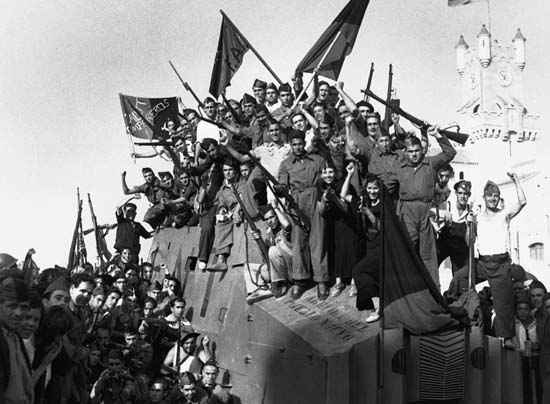
A CNT-FAI armoured car rolls off the collectivised production line, celebrated by anarchist militants, and bound for the front.

The volunteer anarchist militia who fought fascism in the Spanish Revolution are usually reduced to a few of the most famous, especially the Durruti Column - but there were scores more, as I detail in my forthcoming book In the Shadow of a Hurricane: 

All officers were elected by the rank-and-file and had no special privileges, and the militias generally fell under the control of the Central Committee of Anti-fascist Militias set up by the CNT in July 1936. Within the anarchist militia, there were a number of different columns. Deployed by the CNT-FAI-JJLL from Catalonia into Aragon on 24 July, there was the Durruti Column, which fought on the Zaragoza front, lead by Buenaventura Durruti himself, at first consisting of 4,900 militiamen and militiawomen but growing to 6,000, the 2,000-strong Ascaso Column, lead by Domingo Ascaso (whose brother died in the early fighting in Barcelona), Gregorio Jover and Cristóbal Alvaldetrecu, which fought on the Huesca front, the 1,500-strong Aguiluchos Column (including 200 female milicianas), lead by García Oliver and Miguel García Vivancos, which fought on the Huesca front, the Kropotkin Battalion consisting of JJLL youth, also on the Huesca front, the Red and Black Column under García Prada on the Huesca front, the Sur-Ebro Column under Antonio Ortiz which fought on the the Calamocha front, and the Land and Liberty Column under Germinal Souza consisting of volunteers from the failed Republican attempt to retake Mallorca from the fascist rebels, and which defended the free communes of Aragon, which were being established, with the CNT in the lead, collectivising the farmlands, suppressing the fascists, expropriating the latifundista gentry, Church, and bourgeoisie, and establishing worker’s control in the cities and towns. In the Pyrennees, the Sabadell CNT would form an Alpine Battalion which fought with the UGT’s Pyrennean Column under Mariano Bueno. International volunteers – perhaps 40,000 in all – flocked to Spain. Some 250 (later rising to 400) foreigners such as the Algerian anarchist Saïl Mohamed, German IWW veteran Heinrich Bortz and Canadian IWW veteran Louis Rosenberg were organised into an International Group of the Durruti Column, under Louis Berthomieu, which had as its training base the former Pedralbes Barracks, which was renamed the Miguel Bakunin Barracks, and comprised the Sacco and Vanzetti Century (English-speaking), the Erich Mühsam Century (German-speaking), the Sébastien Faure Century (French- and Italian-speaking), and the Matteotti Battalion (Italian-speaking). Meanwhile, several hundred Italians exiled in France – many of them former anti-fascist Arditi del Popolo militiawomen and militiamen (there was actually an office of the exiled USI in Barcelona at the CNT headquarters) – formed the Malatesta Century of the Red and Black Column, nick-named the Battalion of Death, which fought on the Huesca front under Cándido Testa, while other Italians were attached to the Justice and Liberty Century of the Ascaso Column, and after May 1937, Italians formed the 25th Ortiz Division within the Land and Liberty Column. About 40% of the XV International Brigade (incorrectly but popularly known as the Abraham Lincoln Brigade after one of its subsidiary battalions), though it had been organised by the Comintern, consisted of Wobblies and unaffiliated socialists from the USA. There were only four Wobblies and one anarchist volunteer in the Canadian Mackenzie-Papineau Battalion of the XV International Brigade.

In Basque Country, the CNT had been a minority force with less than 3,000 members in May 1936, but the anarchist resistance to the fascist putsch saw their membership soar to 35,000, with 6,000 militiamen and militiawomen organised in the following battalions: the 800-strong Bakunin Battalion (CNT No.1) under Luciano Mateos, the 800-strong Malatesta Battalion (CNT No.2) under Jesus Eskauriaza, the 850-strong Isaac Puente Battalion (CNT No.3) under Enrique Araujo, the 800-strong Sacco-Vanzetti Battalion (CNT No.4) under Juan Rivera, the perhaps 500-strong Durruti Battalion (CNT No.5) under Roberto Lago, the 500-strong Celtic Battalion (CNT No.6) under Manuel Mata, plus a reserve International Battalion (CNT No.7) consisting of about 200 anarchists and others, and the 1,000-strong punitive battalion, the 1st Battalion of Engineers named after Manuel Andrés, in which numerous cenetistas served. In Santander, the CNT’s Freedom Battalion and the CNT-FAI Battalion were formed, but most anarchists were curiously members of the socialist UGT and so joined the UGT’s mixed brigades. On the northern front, the ac-hoc mixed columns numbering 10,000 that had arisen to fight the fascist menace were replaced over September to October 1936 by ideologically-defined battalions. In Asturias, out of 52 Republican battalions, the CNT organised the following ten battalions: CNT No.1 under Miguélez, CNT No.2 under Onofre García Tirador, CNT No.3 under Víctor Álvarez, CNT No.4 under Celestino Fernández, CNT No.5 under Higinio Carrocera, CNT No.6 under Faustino Rodríguez, CNT No.7 under Mario Cuesta, CNT No.8 (consisting of FIJL members) under Marcelino Alvarez, CNT No.9 under José García, and the Galicia Battalion comprising Galician refugees from the fascist invasion of their autonomous community, under Ramón Iglesias, with bases in Avilés and Colloto. In addition, the Syndicalist Party – which peaked at 30,000 members in December 1937 at the time founder Ángel Pestaña died as Republican General Sub-commisisoner for War – formed its own battalion. In the centre of the country, the CNT’s “confederal militia” mustered up to 23,000 fighters by December 1936, with battalions in Madrid and its surrounds such as the 2,215-strong Free Spain Column under Cipriano Mera, Ferrer Battalion (600 strong) under Cayuela, Orobón Fernández Battalion (600) under Miguel Arcas, Juvenil Libertario Battalion (650), and the Bakunin Battalion, and the 1,000-strong Palacios Column under Miguel Palacios, plus the four CNT Espartacus Battalions which arrived from Alicante, Murcia, and Cartagena to defend the capital (and later forming the 77th Mixed Brigade of the Republican Army). There were additionally anarchist battalions which were named after the cities of Sigüenza and Toledo which they defended, while other “cenetistas” (CNT members) integrated into Republican columns such as the 1,000-or-so anarchists who joined the Mangada Column. In Extremadura along the Portuguese border, the Pío Sopena Battalion was formed under Olegario Panchón, while in Bujalance in Córdoba, the 4,000-strong Andalusia-Extremadura Column was organised by the Andalusian CNT by merging the remnants of those who had faced the brunt of the rebel Army of Africa’s invasion of the south: the Bujalance Sparrows Century, the Arcas Battalion and the Zimmerman Battalion of Seville, the Pancho Villa Battalion from Jaén, Castro del Río and Baena, the Acoy Battalion, and the Fermín Salvochea Battalion of Almodóvar del Río and Villaviciosa under the brothers Juan, Francisco and Sebastián Rodríguez Muñoz, and in Málaga the following battalions were formed: Juan Arcas, Pedro López, Ascaso No.1, Ascaso No.2, Raya, Makhno, Andrés Naranjo, Sebastian Fauré, and Fermín Salvochea. Also from Málaga came the CEFA Column organised by the province-wide Spanish Confederation of Anarchist Federations (CEFA) under Captain Hipólito and Morales Guzmán. The Maroto Column under Francisco Maroto del Ojo (1906-1940), meanwhile conducted a successful campaign in Córdoba, in which the fascists were besieged in the city, and Granada, but failed to take the latter city because of a lack of arms.

In Valencia, the 2,200-strong Iron Column was formed by Rafael Martí, José and Pedro Pellicer, Elias Manzanera and José Segarra, and fought on the Teruel front, its membership made up of metallurgists, port workers, freed criminals, and about 600 members of the Nosotros anarchist group earning it a fearsome reputation – not only at the front but as Guillamón notes, by making repteated “visits” to the city of Valencia to forcibly “cleanse” the rearguard of reactionary elements and demand that the Republican state’s Assault Guards and Republican National Guards (the reformed Civil Guards) be dispatched to the front to fight. Also from Valencia came the 1,000-strong Iberia Coumn, formed by FAI-FIJL youth who had been expelled from the Iron Column for various reasons, plus the 1,200-strong CNT No.13 Column under Santiago Tronchoni, the 1,500-strong Confederal Column No.2, and the Malatesta Division (actually a battalion of perhaps 500) which split from the Iron Column over political differences with the ex-Nosotros group’s Pellicer brothers and which joined the mostly-CNT Torres-Benedito Column of 2,600 under Colonel Velasco Echave, which included the Jaime Cubedo Battalion of the Syndicalist Party, which by December 1936 was 30,000 strong. In that month, many fighters from of the XIII International Brigade’s Louise Michel Battalion, consisting of French and Belgian volunteers, disgusted at being used as cannon-fodder by their communist commander, defected to the Iron Column, forming its International Century. It needs to be stressed that most histories of the anarchist resistance during the so-called “Spanish Civil War” focus on the CNF-FAI confederal militia operating on the Aragon front, particularly the Durruti, Ascaso and Aguiluchos Columns, and ignore the experience in the rest of the country, with the exception of the Madrid front, and of the Iron Column – and the latter only because of its virulent opposition, alongside the Durruti Column and the Land and Liberty Column, to militarisation of the militias enforced by the Republican state in 1937. Both before and after militarisation, there were also regular Republican army units that had significant anarchist leaders or anarchist and syndicalist membership such as Gregorio Jover's X Army Corps in the Army of the East, and Cipriano Mera's 14th Division (and later his IV Army Corps) in Madrid. 

[ENDS]

Thursday, 25 January 2018

Democracy & Diversity in light of the Zimbabwean Coup


Radio Freedom, run  by Taurai Mabhachi of Harare (above left), is a new podcast radio station which campaigns to get community radio stations licensed and on air in Zimbabwe. The topic of our pilot show on 30 November 2017 was informed by the November 15-21 military coup d'etat that ousted President Robert Mugabe - what I have termed the "Continuity Coup" as it reinforced ZANU-PF securocrat rule. Our guests included left academic Prof Patrick Bond, veteran former BBC journalist Andy Moyse, former bank treasurer Daniel Ngwira and former Revolutionary Command Council student Dandira Mushangai. We had a few tech issues, so the sound isn't great but those will be resolved in future and we hope this will be the first in a series of 10 broadcasts ahead of the 2018 elections. The first Radio Freedom podcast is available here.

[ENDS]

Thursday, 18 January 2018

Belgium's Failed Guatemalan Colony

My late grandmother, Georgette Hemmerlé, told me her mother, Susana Esmenjaud Estrada, small and dark like her, was of Guatemalan descent and fluent in Spanish, French and "Kuli" (the lingua franca of the "Coolie" labourers). Georgette added other colourful anecdotal details, but I knew very little about that branch of the family - until I met some of them online last year and, in filling in details and sharing photographs of my grandmother as a young girl, sowed the seeds for a historical novel, about the failed Belgian colony in Guatemala. 


Georgette Hemmerlé

The story goes that King Leopold I of Belgium - the father of the psychopath who would steal the entire Congo as his personal fiefdom, enslaving, torturing and murdering millions of Congolese - financially backed the conservative Blanco politician Rafael Carrera y Turcios in his campaign for the  secession of Guatemala from the liberal Colorado-dominated Federal Republic of Central America (1823-1840). Leopold was really only famed as a royal matchmaker, having hooked up Victoria and Alfred, rather than as a statesman, but the bid succeeded and a grateful Carrera repaid Leopold by ceding on 4 May 1841 "in perpetuity" a sizeable chunk of Guatemala's Caribbean coast to a Belgian royal charter company, the Compagnie Belge de Colonisation (CBC), which built a modest little colonial capital, Santo Thomás de Castilla, on the shore of an anchorage in a suitably sheltered bay. An 1844 engraving of the establishment of Santo Thomás shows the usual colonial accoutrements: a church-cum-town hall, a company headquarters, warehouses, company officers, and dark-skinned servants and labourers.


A contemporary map of the colony, located in the Department of Vera-Paz, show it to consist of a generous swathe of varied terrain, stretching from the Caribbean coast, where three Carib villages were located (presumably their inhabitants were handed over to Belgian jurisdiction without consultation), a river, the Rio Dolce, giving waterborne access from the Golfe de Honduras into a lake named Lac d'Isabal, into which the Rio Polochi drains, the gentle backbone of a potentially silver-bearing mountain range, the Sierra del Mico, which loomed over potential plantation lands divided between company-reserved terrain at the coast (tinted yellow in the map below and including the Caribe villages), and a zone (tinted pink) to be sold in 20 hectare plots to holders of private title deeds - presumably colonists like my ancestors - centred on the settlement of Isabal on the eastern shore of the lake and including the hamlet of Santa Catalina on the Rio Montaguilla which marks the border with Honduras.


Three years into the settlement, an 1844 engraving shows two surveyors, one armed with a spyglass and cutlass, looking from the verdant heights of the Sierra del Mico onto Santo Thomás below, with what look like two two-masted topmast schooners and two three-masted barques riding at anchor (it is hard to be sure as their sails are struck), served from the jetty by rowboats. The "capital" has at that stage only seven wood-planked buildings other than the church and company offices already mentioned, so they probably performed multiple functions as store-rooms, victuallers and lodgings. The surveyors are probably determining the commanding location of two future forts each shown on the map above as "Fort (Project)" - one roughly where they are standing and another at the westernmost mouth of the bay, all in line-of-sight of the settlement for semaphore purposes.


But the Belgian colony did not survive for long. Malaria and yellow fever was endemic in the area and most of the colonists perished, winding up in a little cemetery at Santo Thomás (that apparently survived into the 1960s). All that is, except those few like my family who married into the locals, apparently their children being born with immunity. I'm not sure if locals meant mestizo, Caribe or Mayan (the Mayan city of Quiriguá is near the old colony) but my family's darker skin is a legacy of that intermarriage - and the ephemeral settlement occurred against the fascinating regional backdrop of the Caste War of Yucatán in which indigenous Mayans rose up over several decades against mestizo and peninulsare imperialism. The war saw the creation of an autonomous Mayan state - backed by the British - that embraced an area from Tulum in present-day Mexico to the border of British Honduras (today Belize), not far o the north of Santo Thomás. The Belgian presence ended in 1854 when, facing financial ruin, the company withdrew, leaving behind my ancestors and the ruins of what would in the 1960s become the home base of the Guatemalan Navy. I thought the tale of a failed 19th Century tropical colonial experiment would make for a great historical novel, something of the tenor of Bruce Chatwin's The Viceroy of Ouidah, so I am researching this further!

[ENDS]


Monday, 15 January 2018

The Makhnovist free cities, their "navy" and bomber aircraft

In contrast to most accounts of the Makhnovists as "peasants with pitchforks" my book In the Shadow of a Hurricane will focus on its control of cities such as Berdyansk - and their deployment of at least one aircraft (below), four armoured trains (below), and a steamship in battle. The first proper studies of urban life under Makhnovist control are so far only available in Ukrainian: on Mariupol (Zhdanov), which had a 1917 population of 45,000, Lev D. Yarutsky, Makhno and the Makhnovists, self-published, Mariupol, Ukraine, 1995, online at http://www.padaread.com/?book=52032 ; and on Berdyansk which had a 1917 population of 47,000, Vladimir M. Chop and Igor I. Liman, Free Berdyansk: The Life of a City Under an Anarchist Social Experiment (1918–1921), AA “Tandem-U”, Zaporozhye, Ukraine, 2007, online at www.i-lyman.name/FreeBerdjansk.html. The key study on Odessa, which by 1914 had a population of 481,000, and of powerful anarchist formations based in the port city such as the Union of Black Sea Sailors (SCM) of 1906-1918, is also in Ukrainian: Viktor A. Savchenko, Anarchist Movement in Odessa 1903-1916, Almanac Publishing House, Odessa, Ukraine, 2014, but the second volume on the period 1917-1929 is yet to be published. Thanks to Ukraine specialist Malcolm Archibald for directing me to these sources.


French-designed Farman 30 biplane bomber as flown by the Makhnovists, built under license in Berdyansk


Artillery car of the Revolutionary Insurgent Division armoured train, the Terrible

The RPD’s [Revolutionary Insurgent Division's] transformation from a Black Guard guerrilla unit into a specialised modern military formation, the 3rd Dniepr Brigade (3rd DB) was complete – and this was the “Black Army” that, with several captured armoured trains, liberated the Azov Sea port of Berdyansk on 15 March 1919. Chop and Liman describe the taking of Berdyansk in great detail. [This includes the establishment of the Berdyansk Free Soviet there, but I have extracted this section for the purposes of this post]. Chop and Liman stress: “The role of Berdyansk in the history of Makhno is unique. The city was extremely important for the Makhno republic, ‘a free homeland of anarchy’. It was the only complete port of this political formation, the city where the navy and air forces of the Makhno movement first began to form. It was in Berdyansk that for the first time, in full swing, the Makhno and Bolshevik ambitions and elites were in competition for the city center. But this is not the main thing. Berdyansk was the longest of all the cities of Ukraine and Russia under the control of the Makhno rebels. Six times they were in combat, then bloodlessly seized the city and managed it for a long time, carrying out measures of its internal policy. For the first time – in March - June 1919, the second time – in October - November 1919, the third time – in December 1919, the fourth – in November 1920, the fifth – in December 1920, and, finally, in the sixth – in January 1921.”

In the city, which was an important wheat, leather and wine market and industrial centre of agricultural machinery and war materiele production, the Makhnovists found the Shroeder & Matias aircraft factory where the remains of five Farman 30 biplanes sabotaged by the Whites had been left; these were cannibalised by the Makhnovists to make one complete aircraft – the RPD’s sole operational combat aeroplane, armed with a machine-gun and capable of carrying several small bombs. Chop and Liman note that the 3rd DB aircraft was soon flown against enemy forces in taking another Azov port, that of Mariupol to the east of Berdyansk, on 29 March: “The plane took part in the capture by the Makhnovists of Mariupol, from March 28 to 29, 1919; the Farman-30 had a sufficient supply of fuel to fly from Berdyansk to Mariupol and to return. In addition to conducting intelligence, the airplane threw bombs on the territory of the Mariupol port, focused on enemy artillery. In addition to the White Guards, there were also troops of French interventionists and Czechoslovak legionnaires.” The Makhnovist capture of the Azov ports lead to the seizure of enormous quantities of ammunition and equipment from the fleeing Whites, while the 2nd Brigade of the Zanoprovsky Division under former Tsarist officer Nikofor Grigoriev liberated Odessa. In mid-March, two carriages of anarchist literature were sent to Berdyansk and Mariupol, accompanied by anarchist (Nabat?) and Left SR militants; detained by the Reds, their ownward passage had to be negotiated by the Makhnovists.The Farman 30 was used to dramatic effect once more on 31 March when Makhno, uncovering a Boslhevik-sponsored plot to assassinate him, was flown in the plane from Berdyansk to Gulyai-Polye in two and a half hours, roused a local Makhnovist unit which captured the plotters and shot them immediately. Chop and Liman write, however, that “Makhnovists would [in the future] be able to capture airplanes several times as trophies. But, in the absence of skilled pilots and fuel, they would never rise into the air."

Chop and Liman write that even though the Whites had evacuated the bourgeoisie from Berdyansk on the last available gunboat and steamer, leaving the port with no vessels of any size or fighting capacity, in early April the Makhnovist commander Seymon Karetnik acquired a steamer which his men used to ply between Mariupol and Berdyansk; the Makhnvists now had the core of their own tiny navy, crewed by sailors sympathetic to the revolution, likely including members of the famous Odessa-based anarcho-syndicalist Union of Black Sea Sailors; the Makhnovists apparently later acquired a fleet of tugboats too – but this requires further research: “A little ship was repaired a week after the appointment of S. Karetnik in Berdyansk. The head of the garrison took it under his personal control and wanted to make a visit of respect with the ship to his neighbors, to the commandant of the Makhnovists of captured Mariupol… Vasily Kurylenko. For the first time in the history of the Sea of Azov from the port of Berdyansk came a ship with a black-flagged mast.” The authors note that this was a dangerous voyage as the Azov detachment of the White Don Flotilla including the submarine Seal was still active, and “in the sea also swam British and French warships. Just at Mariupol, there were French gunboats and destroyers. They were in talks with the Makhno delegation regarding the fate of coal stored in the Mariupol port. And, at the very height of these negotiations, S. Karetnik's steamer under a black flag broke through the line of French ships. The command of the latter was rather angry. The forceful action of the Karetnik ship seemed to disgrace the French tricolor. The French even demanded to give them the Berdyansk steamer, but the Makhnovists categorically refused to do so. Rather, travelling back and forth from the port of Mariupol, the steamboat was not released to the French.” This amusing event reveals firstly that the Makhnovist vessel was probably a civilian craft – else Chop and Liman would have called it a gunboat or somesuch – though doubtlessly, it was weaponised with makeshift armament like artillery and machine-guns, and then that in the fluidity and chaos of the Civil War some highly unusual situations could develop, as with the French forces trying to beg coal off the Makhnovists who had just expelled them from the port. Vasily Kurylenko, who had joined the Makhnovists at the end of 1918 after serving after the outbreak of the Revolution as the head of the Yekaterinoslav Military Bureau, was installed as Mariupol’s military chief. He was awarded the Order of the Red Banner by the Bolsheviks for his actions in a string of six battles that included taking Berdyansk and Mariupol, and his 1st Novospasivsky Divison garrisoned the city. 


 The RPD's 1st Novospasivsky Detachment poses for the camera with its black flag flying.

[ENDS]